
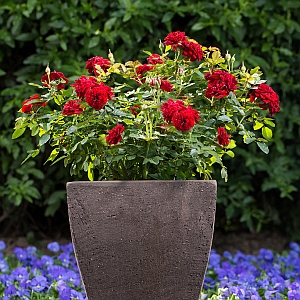
For many aspiring rose growers, the idea of growing roses evokes images of a large doted over landscapes, with sprawling garden beds, and high maintenance plants. But today’s rose growers are changing that picture. More people than ever are living apartments, town homes, or homes with limited outdoor space, yet they still want to experience the beauty and satisfaction of growing roses to enjoy.
The good news is that you don’t need a large yard to become a successful rose gardener. A sunny patio, balcony, deck, or front porch can become the perfect place to grow beautiful roses in containers. In fact, for many beginners, growing roses in pots is one of the easiest and most rewarding ways to get started. Many roses are naturally compact, making them perfectly suited to containers. You may even find that some varieties perform better in pots than in the ground.
Container gardening removes many of the barriers that discourage new gardeners. You can start small with a single rose, learn as you go, and expand your collection as your confidence grows. Growing in containers allows you to create a garden almost anywhere, and before long, that one container may turn into a patio full of blooms.
Choosing the Right Container
Here’s the good news: there really is no wrong answer when choosing a container. Here at the nursery, we grow roses in all kinds of containers: plastic pots, cinder block planters, ceramic decorative pots, hanging baskets, and even an old goat trough that we drilled a bunch of holes in. This is your official permission to be creative in what you choose, there are tons of right answers.
That said, there is one big wrong answer that you really must avoid. You have to choose a pot with good drainage. If you choose a pot with little or no drainage you will run into problems with excess moisture killing your roses. Try this test if you have questions about drainage. Fill your pot half way with your potting mix and saturate the soil so you can see water in the mix. Wait about 20 minutes and grab a handful of soil. If you can squeeze more than a drop or two of water out of the soil, you may need to choose a different container. Remember roses love water, but the like to dry out between waterings and they definitely don’t like sitting in water for extended periods of time.
I always caution people about what size pot they want as well. I encourage you to really think about how you want to live in and around your pots. It is easy, and in our nature, to assume bigger is better. Know that the roses will be just fine long term, in pot sizes as small as 1 gallon (7″). I would say the ideal size is somewhere between a 2 gallon (8-10″) and 5 gallon (12″-14″). That gives the rose plenty of space to develop a dense root ball and is still mobile on a patio or deck.
Benefits of Growing Roses in Containers
One of the things I like about growing roses in containers is that it gives gardeners a great deal of control over their growing conditions. Let’s start with the soil. A good rule of thumb is use the rule of thirds: 1 part potting mix (make sure to get a high porosity or high drainage mix), 1 part compost (you want organic material breaking down in the soil) and 1 part existing garden soil. This ratio gives your container a good balance of organic nourishment and helps with regulating moisture content.
When watering your rose, it is far easier to add too much water to your pot than not enough. Make sure your container has a good drainage path. If necessary, add a layer of stones at the bottom of the pot beneath the soil to help excess water drain away. Try to maintain soil that is moist for a majority of the time. This may take a little trial and error at first, but generally that means watering your container rose 2 to 3 times a week.
Being contained, you also control the nutrients your rose needs to survive. This means fertilizing (or simply adding nutrients) on a regular basis. If you are starting by mixing in compost when you plant, you’ve got a great head start. I like to feed my plants with natural products that break down over time. Darn Good Fertilizer is a great product along those lines, with an organic formulation that breaks down slowly. You can apply it as many as three times a growing season. My recommendation is the same for any fertilizer: wait until your rose is actively growing, then start slow. Read your fertilizer’s label and start at about 1/2 strength. Again, it’s easy to over-love your rose, but growing in containers puts you in control.
Choosing the Best Location
Chances are you may be pretty limited in the location you have to grow your container in. Remember, there’s the ideal—and then there’s the real. As long as you have reasonable expectations, don’t be afraid to give a tough location a try. Ideally roses like about 6 hours of direct sunlight a day, but that doesn’t mean a rose is going to shrivel up and die in 2 hours a day. What likely will happen is you will have a little smaller plant that blooms a little less. There are a number of Shade Tolerant roses that may well thrive in your location. On the other side of the ledger, choose a location that offers some relief from full exposure. Patios in particular can reflect a lot of heat and dry your roses out quickly.
I’ve written an entire blog post on Winter Protection for containerized roses. Do know that this is an important point to consider. Placing a rose above grade does make it less cold tolerant to winter’s challenges. I suggest being proactive in selecting not only your container but your rose if you live in one of these locations.
Ultimately, the beauty of container gardening is control and flexibility. If your rose isn’t performing as well as you’d hoped, you can make changes to improve the growing conditions. Maybe the rose needs a brighter corner of the patio, or maybe a more sheltered location, and you get to try it and see how it responds. Try doing that in the middle of your garden beds!
Choosing the Right Rose
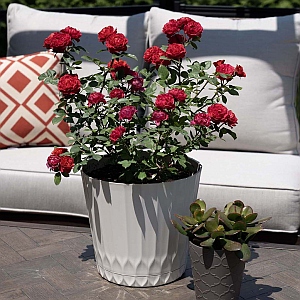
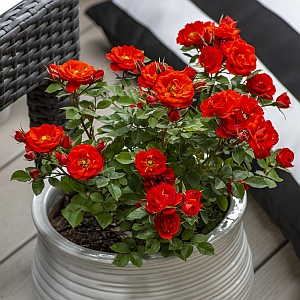
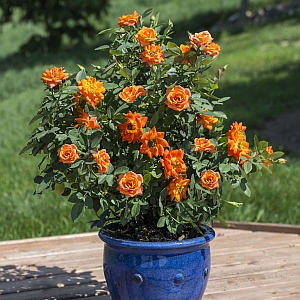
Fortunately, most roses will grow quite successfully in pots. At High Country Roses, we maintain about 2500 stock plants in 3 to 5 gallon pots. Not all of them grow perfectly, but we have a number of roses that are well over 30 years old and thriving. For growing in limited spaces I recommend choosing compact, vigorous roses that will set you up for success. It’s always a lot easer to add plants to an area than to end up with a rose that’s too big and taking over.
When selecting a rose for a container, consider choosing one that is hardy to at least one USDA Zone colder than where you garden. Because the roots of a potted rose are exposed to winter temperatures from all sides, they don’t receive the insulating protection that garden soil provides. A rose that’s hardy to a colder zone has a greater margin of safety and is more likely to thrive for years to come.
Container gardeners should also consider growing own-root roses whenever possible. Unlike grafted roses, own-root plants grow entirely on their own root system. If winter cold or other stresses damage the top of the plant, an own-root rose will simply regrow as the same variety. There is no concern about unwanted rootstock taking over. Own-root roses also tend to develop naturally balanced plants over time, making them excellent long-term choices for containers.
Here are a few of my favorite rose categories and varieties for containers:
Miniature Roses
Miniature roses are among the very best choices for patios and balconies. Their naturally compact growth, continuous bloom, and manageable size make them ideal for containers.
Sweet Chariot bred by Ralph Moore, has long been a favorite for containers. Its fragrant lavender-purple blooms and slightly cascading habit make it especially attractive spilling gently over the edge of decorative pots or elevated planters.
Whimsy is another excellent choice, producing abundant blooms on a compact, well-behaved plant that fits comfortably into smaller spaces.
For gardeners looking for dramatic color, Midnight Fire offers rich, eye-catching blooms while maintaining the compact growth habit that makes miniature roses so well suited for containers.
Floribunda Roses
If you like larger flowers and fuller plants, compact floribundas are outstanding container performers. Floribundas are renowned for consistent and prolific blooming. The plants tend to be a little larger, reaching 3 to 4 feet tall and many of the modern varieties have outstanding disease resistance.
Sparkle & Shine lives up to its name with cheerful yellow blooms that flower repeatedly throughout the growing season.
Cinco de Mayo has become a favorite for its unusual smoky lavender, russet, and brick-red coloring that changes with the weather and light, creating constant visual interest.
For those who enjoy cooler tones, Lavender Veranda is an excellent choice. Its soft lavender blooms and naturally compact growth make it one of the finest purple roses for containers.
Polyantha Roses
Polyanthas may be the most underappreciated roses for beginner gardeners. Naturally compact, exceptionally floriferous, and generally easy to grow, they seem almost designed for container gardening.
Margot Koster produces abundant clusters of colorful coral toned blooms throughout the season and performs beautifully in pots.
The Fairy has earned its reputation as one of the finest landscape and container roses ever introduced. Its graceful sprays of soft pink flowers seem almost endless from late spring through fall.
The Gift rounds out this group with dependable blooming, attractive foliage, and excellent garden performance, making it another wonderful choice for beginning rose growers.
Growing Tips Container Roses
- Container roses appreciate a consistent routine.
- Consistently moist soil is best for your roses, but don’t be afraid to water deeply if the soil begins to dry, allowing excess water to drain freely from the bottom of the pot.
- Nutrients will become depleted more quickly in your containers, fertilize regularly throughout the growing season preferably using a natural fertilizer.
- Adding a layer of mulch to the surface helps conserve moisture and keeps the root zone cooler during the summer months and warmer in the winter.
- Remove spent blooms to encourage additional flowering and maintain an attractive appearance. Occasional light pruning will keep plants healthy and well shaped.
- Choosing a rose that is hardy one zone colder than your garden greatly improves its chances of thriving year after year.
A Rose Garden for Everyone
One of the greatest misconceptions about roses is that they require a large garden and years of experience. Nothing could be further from the truth.
Container roses prove that anyone can enjoy these remarkable plants, regardless of where they live. Whether your outdoor space is a spacious patio or a tiny apartment balcony, a well selected rose can provide years of colorful blooms, wonderful fragrance, and the simple satisfaction that comes from growing something beautiful.
You don’t need a large garden to become a rose gardener.
Sometimes all it takes is one pot, one rose, and the willingness to begin.