
Bring on the mutants! No, I’m not talking about epic battles of good and evil or even cartoon turtles. I’m talking about the actual genetic mutations happening daily in rose plants around the world. In the most basic terms, rose sports are naturally occurring genetic mutations that appear on a single shoot, branch, or flower of a rose plant and are visibly different from the rest of the plant. Unlike variations that arise from sexual reproduction (in the rose world, it’s usually purposeful hybridizing by cross pollination), a sport arises from genetic changes in the non-reproductive cells of the plant. These genetic changes can affect many traits, including flower color, petal count, growth habit, thorn density, fragrance, or even disease resistance.
Ultimately, a rose sport is a genetic “mistake” that turns out to be interesting, beautiful, or simply commercially valuable.
On a cellular level, plants grow from specialized regions called meristems that contain cells that divide repeatedly to produce new tissues. These tissues become stems, roots, leaves, flowers and any other growing part of the plant. In roses, the meristem is organized into layers, and each has a different effect on the plant’s characteristics. For instance, a genetic change in one part of the meristem may affect the color of a rose’s bloom and a change in a different area may result in long climbing growth. Sometimes these changes are temporary but many times the new genetics will persist.

Interestingly, roses have a particularly fertile genetic make-up that fosters change through sporting. Characteristics like their relatively long life span, their complex chromosomal makeup, and their propensity for fluid gene variation, make roses great incubators for rapid genetic change. Changes that may take millennia in the rest of the natural world can be seen within a few generations in roses.
In addition to their natural predilection for change, roses are one of the most propagated plants on earth. Propagation allows a stable mutation to be replicated and preserved as a unique variety. This is one of the reasons we have to be careful in tracking the source of our cutting material for production. Taking cuttings from successive generations without maintaining true genetic stock plants can result in genetic drift and plants that aren’t genetically true.
Many commercially successful roses were not created by deliberate breeding, but by selecting and propagating sports discovered in gardens or nurseries. A great example of this is the rose Petite Peach. Petite Peach is a sport of the rose Petite Pink and was found growing in our good friend Teresa Byington’s garden (you may know Teresa from the RoseChat Podcast!). After observing the unique rose for a few seasons, Teresa suspected she was on to something new. Eventually, she sent us cutting material and we began propagating the rose commercially.
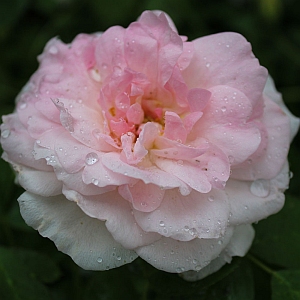
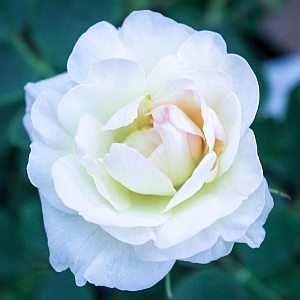
The rose Peace is another great illustration of how sporting occurs and leads to new varieties being released commercially. The story of the Peace rose could be an article unto itself, but in brief, the rose was developed in France in the 1930s by Francis Meilland and then smuggled to the United States during World War II. Meilland knew it was a special rose and he released it to celebrate the end of the war in Europe. Peace went on to become one of the most commercially successful roses of all time.
Peace also happens to be prolific at producing sports. A quick internet search turned up over 25 unique sports of Peace either released commercially or used in breeding. Many of these are color sports, with the most famous roses being Chicago Peace, Flaming Peace and Lucky Peace. Peace also experienced a mutation in the growth area of the meristem and the result was Climbing Peace. Just like that, Peace’s creamy yellow blooms were covering trellises and walls reaching heights of 20 feet or more.
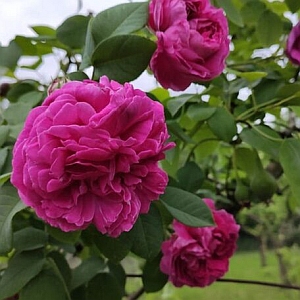
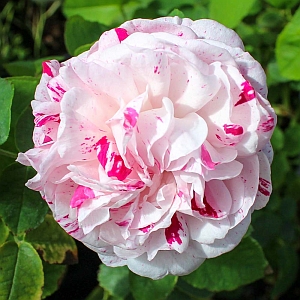
One final note of interest: not all sports are stable, and some will revert to original genetics. A few seasons ago, we had an issue with the rose Variegata di Bologna, a lovely old garden rose featuring bold striped blooms. The parentage of this variety is the subject of some debate, but one common theory is that the rose is a sport of the Bourbon rose Victor Emmanuel. Unbeknownst to us, one of our stock plants sent up a cane that had reverted and we accidentally put it into production. It didn’t take long for the calls to come in letting us know that people’s beautiful striped roses were blooming deep red instead. Fortunately, we were able to quickly isolate the source and replace the reverted roses.
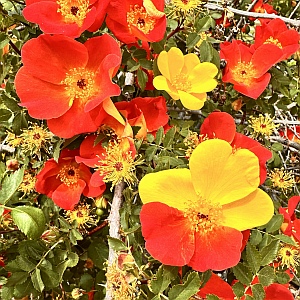
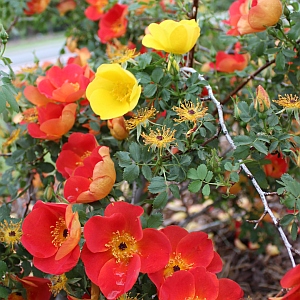
One of my favorite roses, Rosa foetida bicolor (Austrian Copper) takes the sport and reversion relationship a step further. Austrian Copper grows with two distinct sets of genetics in the same plant. This creates a number of unusual expressions. Sometimes, you will see pure copper red blooms covering the plant. Sometimes, you’ll see the pure yellow blooms of the parent plant Rosa foetida. On occasion, you’ll see both. Not only on the same plant, but in the same bloom.
The next time you are wandering through your garden and you see something unexpected with one of your roses, take the time to explore a little deeper. It may just be one of nature’s “happy accidents” and remember, mutants are everywhere.