
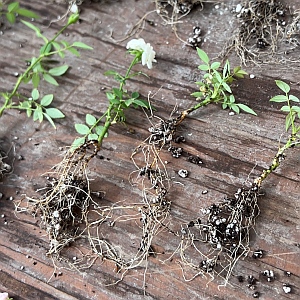
Our Own-Root Roses
All of our roses are grown on their own roots, which means that they are grown directly from cuttings and not grafted onto a different rootstalk. There are several benefits to purchasing own-root roses as compared to grafted roses which are typically sold at large retail outlets. For more information on own-root roses, see below.
Advantages of Own-Root Roses
- Own-root roses have a longer life expectancy.
- Own-root roses have increased vigor and bloom.
- Own-root roses tend to be more cold-tolerant than their grafted counterparts.
- Own-root roses can freeze all the way to the ground and because they have their own root system, they come back as the same rose originally purchased.
- Own-root roses may naturally send up genetically true shoots from the soil, which eventually creates a shapelier bush than a grafted rose.
- Eliminates the possibility of rootstock suckers and rootstock emergence.
- Own-root roses guarantee that your roses will always be the same rose you selected at the time of purchase.
Propagation of Own Root Roses and How They Compare to Grafted Roses
Each year, High Country Roses produces about 40,000 rose plants on their “own roots” through a process called asexual vegetive propagation. Asexual vegetative propagation is a plant reproduction method that creates a genetically identical new plant (sometimes referred to as a clone) by inducing roots to grow on harvested stem sections of parent roses.
When we are propagating own root roses, we apply plant hormones called auxins to actively growing nodal sections of the rose stem. These auxins are found naturally in all parts of the plant, but in varying concentrations. Hormone concentration is central to the “job” the cells are called to perform. In this case, the application of additional hormones essentially reprograms the stem cells and induces them to grow roots. The result is a rooted stem cutting that is genetically the same from the tip of the root to the end blossom.
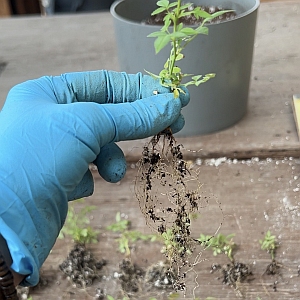
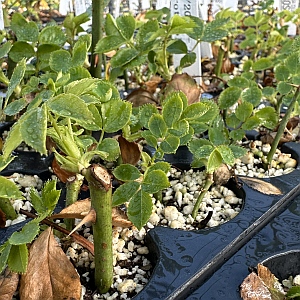
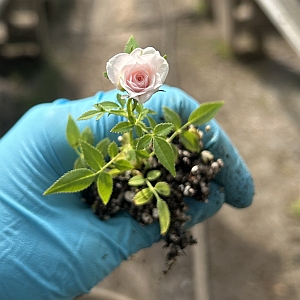
While this may seem logical, not all roses are produced this way. Starting in the late 19th century, “grafting” became the primary way roses were commercially produced. Grafting is a horticultural technique where tissues of plants are joined to continue their growth together. In practical terms for roses, the desirable top growth of a rose variety is attached to the stronger root stock of another rose variety.
The rise of grafting as a production method corresponded with the popularity of Tea and Hybrid Tea roses. The early hybrid tea roses tended to have relatively weak natural root systems. To give the plants a boost, improve garden performance, and increase sales, the roses were grafted on stock with better developed root systems. Undoubtedly, this method was an effective means of production and fueled the rose boom for decades, but problems with grafted roses do persist today.
The most common issue, especially in colder areas, is the occurrence of root stock emergence, or literally the root stock coming up from below the soil level and taking over the desired top of the plant. If you ever had a rose you purchased bloom its intended color one year, only to come back the next year a different color, you’ve experienced root stock emergence. Grafted roses also tend to have a shorter overall life span, as well as decreased cold and disease tolerance, in comparison to own root roses.
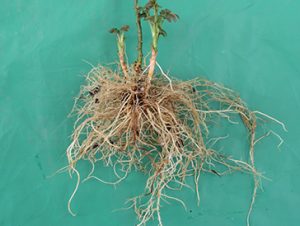
Own-root roses offer significant long-term advantages compared to grafted roses. This is especially true in terms of durability and consistency. The entire plant grows from its own genetic material which eliminates the potential failure of the graft union. Own-root roses may die back in the winter, but they come back true in the spring.
Another major benefit of own root roses is their natural growth habit and longevity. Own-root roses tend to establish more slowly at first but once settled they develop strong root systems that support healthier more resilient plants. Over the years, this results in a more stable plant that maintains its intended form, bloom quality, and fragrance. This sustained quality makes own-root roses well worth the investment.
A Final Note
Many people confuse the term “own-root” with “bare-root.” That’s an easy one to mix up. Just remember own-root is a propagation method contrasted with grafting. Bare-root is a production method utilizing dug up field grown plants and contrasted with container grown roses. Our roses are own-root and container grown.